
Mission
Bring information, care and operations closer together so teams can find the context they need to work.
Interactive project map
Select a sector to see its blocks and specialties. Switch to Engines to explore the functions behind Desiderium One.
On a unit transfer, the receiving team sees what is pending and who is responsible.
View the 18 blocks ↓Select a point to discover its role.
Employment records, staffing, shifts and leave.
Sectors
Select a sector to explore its map.
The map presents the engines in three groups of five. Each point describes a responsibility within the architecture.
Before a screen opens, five engines establish the institution, available functions and access.
When a record changes, events, rules and workflows carry the information to the next step.
When reviewing a result, a team can trace the source, interpret the indicator and examine discrepancies.
Blocks
Select a block to read its summary.
Policies, risk, quality and audit.
Employment records, staffing, shifts and leave.
Recruitment, onboarding, skills and career development.
Performance, succession and team coaching.
Benefits, recognition, payroll and employee feedback.
Occupational health, employee portal, payables and receivables.
Budgets, treasury and operating costs.
Suppliers, purchasing, contracts and material traceability.
Equipment, calibration, maintenance and facilities.
Admission, beds, patient records and handovers.
Outpatient, emergency, intensive and surgical care.
Pharmacy, laboratory, imaging and therapeutic services.
Oncology, maternal and newborn care, rehabilitation and transplants.
Mental health, dialysis, home care and palliative care.
Care financing, care networks, surveillance, teaching and research.
Assessment tools, indicators and data exchange.
Institution and partner relations, training and implementation support.
Support, releases, recovery and environment simulation.
About Desiderium
Desiderium is the initiative behind Desiderium One, an institutional platform in development. One question guides the work: when a decision passes between teams, how can the information the next person needs travel with it?
Bring information, care and operations closer together so teams can find the context they need to work.
Design a platform suited to different institutions and to journeys that cross several services.
Clear interfaces, privacy in data use, accountable decisions and traceable information.
Listen to the people doing the work, respect local differences and preserve the judgement of those providing care.
Governance
Paulo Batista Rocha envisions Desiderium as a one-person company. He chooses the problems to pursue, sets priorities and decides when a stage is ready to move forward. AI tools contribute to research, writing, software development and review. The founder takes responsibility for what becomes part of Desiderium One.
Product in development
In developmentNo commercial offerHow can the same information help the person giving care, the person organising the team and the person planning resources?
Desiderium One explores how to connect a patient’s journey with the operations that support it. The workspace below is an interface from the development environment.
When patients move between departments, we study which records need to follow them and how to make outstanding tasks visible to the receiving team.
The workspace in development brings schedules and tasks together. The aim is to help each professional see what needs their attention in the context of their role.
Integration design considers where information comes from, how the receiving system identifies it and how updates can be traced.
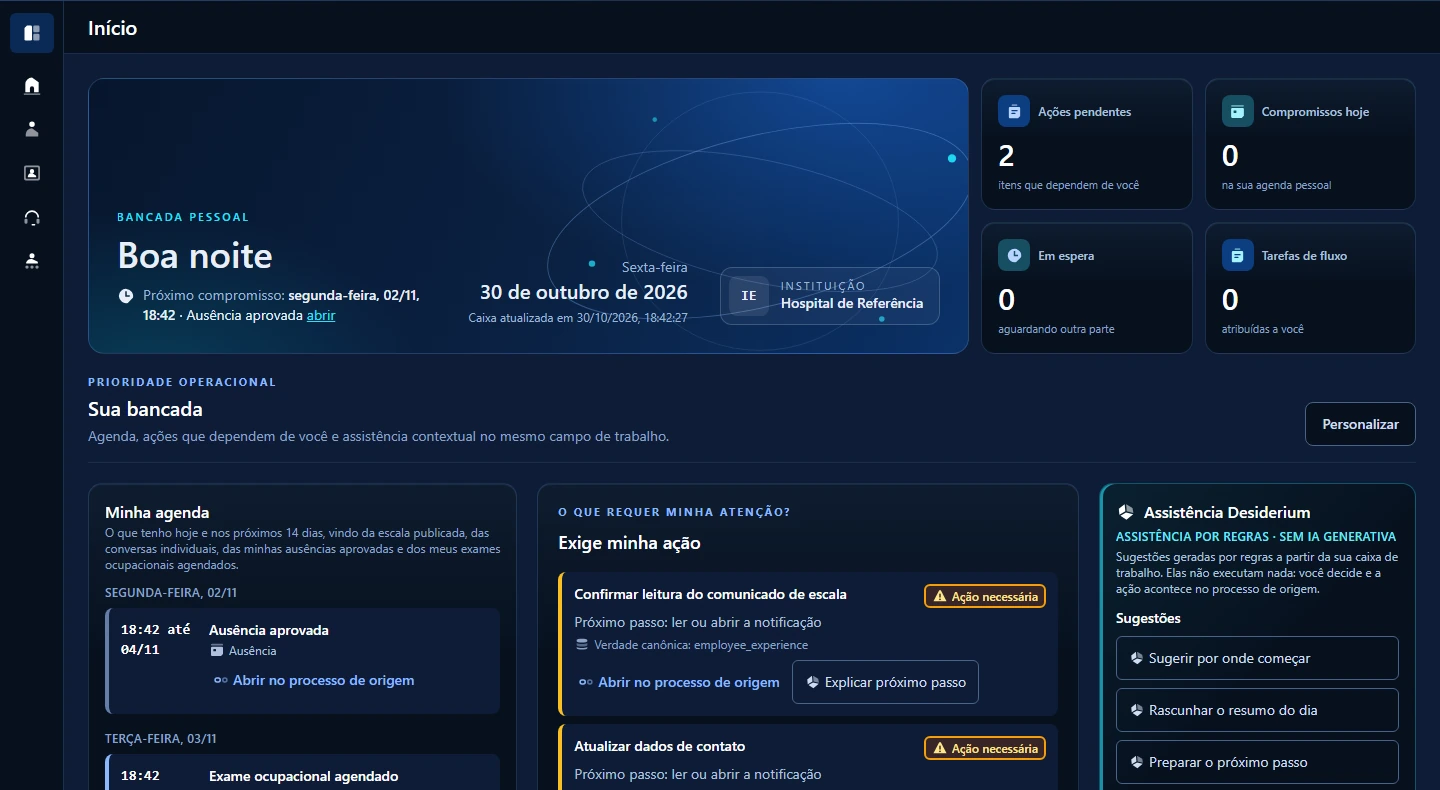
Journeys and data
Imagine that one unit records a transfer request and another records the arrival. Those two timestamps can help the team taking over care, reveal a recurring delay and inform a quality review. The aim is to get more value from each entry and spare the team from having to enter the same information twice. Each dashboard reflects the purpose and access permissions of the person using it.
Illustrative dashboard · simulated data
The receiving team sees that arrival has yet to be confirmed. The next step is visible at shift handover.
Governed AI
The institution sets a limit for each task. The same assistant may explain a rule in one context and prepare an action requiring an authorised person’s confirmation in another.
Points to the passage in the protocol that guides handover.
Suggests ways to record an outstanding task and explains their limits.
Drafts a revision. The team edits the text and checks its sources.
Prepares the revision for routing, identifies who is affected and requests human confirmation.
With assistance off (A0), the team handles the task. Limits depend on the person’s role, the purpose and the risk.
See how a team might use a single shift handover tool. The colours illustrate how deeply the tool is used in a given process. The institution sets AI permissions separately.
Quality and readiness
The starting point is the journey of the person doing the work. At each stage, their experience, the risks they face and the evidence available shape the review.
The catalogue describes 63 journeys, from onboarding a staff member to transferring a patient. Brazil and Germany, the latter within the European Union, are the first reference contexts. For a handover, the project examines who records it, who can see it and which local obligations follow the record.
Development combines incremental delivery, journey mapping, risk analysis and review against acceptance criteria. A change in requirements triggers a fresh look at its impact. Readiness decisions require supporting evidence.
ISO 7101 guides the study of quality management in healthcare. Programmes from ONA and Joint Commission International (JCI) inform research into continuity of care, accountability and assessment evidence. Accreditation of an organisation is a separate external assessment.
The design calls for access by role, a history of changes and data protection. Redundancy, recovery and restart exercises are readiness criteria. The guiding question is whether a team can identify what it needs to recover and resume a journey after an interruption.
Founder
Paulo Batista Rocha began his technology career in the automotive sector. He coordinated IT activities, worked on industrial automation and management systems, and saw how a new system changes the working day of the people who use it.
He earned a nursing degree and completed postgraduate training in nephrology nursing. His clinical and teaching experience includes intensive care, haemodialysis, paediatric kidney transplantation and nursing education.
He led implementations in Brazilian community mental health centres (Centros de Atenção Psicossocial, CAPS) and the structuring of hospital processes. Working alongside care teams brought workflow design, staff education and user acceptance testing together. Studies in agile methods, data science and artificial intelligence complemented that experience. Desiderium One grew out of this meeting of technology and care.
Contact
To discuss a concept, suggest a reference or ask about material on this site, write to the project email address.